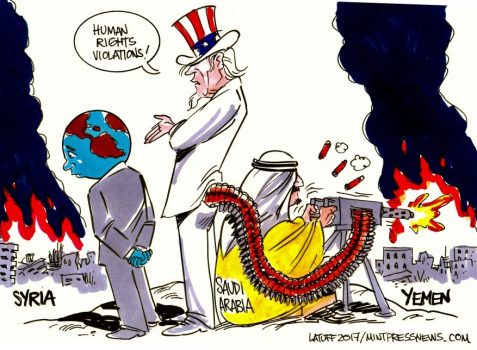
UNCLE SAM’S NEW IMAGE
March 27, 2013 at 07:40 (Associate Post, Cartoons, Genocide, War Crimes)
IMAGE OF THE DECADE
March 24, 2013 at 13:41 (War Crimes, Corrupt Politics, Iraq War, Just Plain Disgusting)
BEHIND THE LENSE AT THE WORLD PRESS PHOTO CONTEST
February 19, 2013 at 08:35 (Ethnic Cleansing, Eyewitness Report, Gaza, Israel, Palestine, Photography, War Crimes)
Award-Winning Photo Shares
|
|
Paul Hansen of Sweden, a photographer working for the Swedish daily Dagens Nyheter,
poses holding his picture that won the World Press Photo of the year for 2012, at Dagens Nyheter’s
office in Stockholm Feb. 15, 2013. (photo by REUTERS/Fredrik Sandberg/Scanpix)
|
|
By: Dalia Hatuqa*
|
On the evening of Nov. 19, a bomb dropped by an Israeli aircraft struck the Jabalya refugee camp home of the Hijazi family, tearing it down and killing Fouad Hijazi and two of his infant sons. This horror story was one of many told by neighbors and loved ones, and documented by Human Rights Watch (HRW) (among other groups) in the aftermath of the Israeli onslaught on Gaza last year. In addition to crushing Fouad and his two sons — Mohamed, 4, and 2-year-old Sohaib — the bomb that leveled the two-story cinderblock house wounded Fouad’s wife, Amna, and the rest of their children.
The aftermath of this tragedy was documented by Swedish photographer Paul Hansen, who captured the funeral procession taking the two toddlers to their burial site. The picture, which shows weeping men holding the children shrouded in white cloth with nothing showing but their listless faces, earned Hansen the 2012 World Press Photo award. Hansen’s picture, one of the many searing images of the eight-day war in Gaza, was taken just one day after the Hijazis were killed, as their bodies were marched through the neighborhood to the cemetery and as their mother lay in an intensive care unit, unable to receive or be consoled by mourners and now homeless.
A staff photographer for Sweden’s Dagens Nyheter newspaper, Hansen submitted the image as just one of more than 103,000 photos sent by 5,666 photographers from 124 countries. Awards in nine themed categories were given to 54 photographers from 32 countries under what is widely known as one of the most prestigious prizes in photojournalism.
Hansen’s picture is telling: Out of last year’s 165 Palestinians killed throughout Israel’s “Operation Pillar of Defense,” at least 33 were children, according to numbers provided by the UN Office for the Coordination of Humanitarian Affairs. During the November onslaught, “several Israeli missiles and a bomb struck civilians and civilian objects, such as houses and farm groves, without any apparent military objective,” said Human Rights Watch, which determined earlier this week that these air strikes were in violation of the laws of war.
Cameras did not capture many of the deaths during that time. Of these, HRW mentions “three men in a truck carrying tomatoes in Deir al-Balah and a science teacher who was sitting in his front yard with his 3-year-old son on his lap, talking to an acquaintance — only the toddler survived, but was seriously wounded.” Israeli-manned drone attacks also killed a 79-year-old man and his 14-year-old granddaughter in the family’s olive grove in Abasan, and a young woman in her backyard in the town of Khuza’a.
On Nov. 18, an attack on a Gaza City house led to the death of 12 people, the single largest number of Palestinians killed in a single incident throughout the war. One day before the Hijazi family tragedy struck, an Israeli bomb leveled the three-story house of the Dalu family, killing ten of its members and two neighbors. Of the family, one man, five women, four children, a grandson and grandmother who lived next door were killed, according to HRW. The strike only spared a 16-year-old, who survived the attack, in addition to the head of the household and his son, who had gone out to buy food.
Gaza was still reeling from this tragedy (the bodies of two of the victims — Yara and Mohamed Al Dalu — were not recovered until Nov. 22) when the Hijazi family was struck. The harrowing retrieval of the bodies of Fouad, Mohamed and Sohaib Hijazi was captured on video. According to HRW, no one knew why their home was targeted. A neighbor was quoted as saying no shooting was ever heard in the neighborhood, and according to the group, the Israeli Intelligence and Terrorism Information Center stated that the three victims were “non-involved” civilians.
The rights group’s field investigations of the incident found no evidence of any military objectives at the time of the attack. Under international law, individuals who deliberately order or take part in attacks which target civilians or civilian infrastructure — whether intentional or unintentional — are responsible for war crimes.
Labels by Israeli authorities aside, the human loss captured by Hansen’s camera is striking. The body of the father of two can barely be seen in a stretcher behind the grieving men carrying the dead toddlers. What Hansen’s camera left out was a story of a family that was at home, many of its members just watching television one November evening before they met their doom. Nur Hijazi, 18, relayed to HRW the events of that fateful night. “Mohamed and Sohaib were with my father in another room. The rest of the family was in another room watching TV. At 7:30, I saw the whole place turn red and suddenly the whole house collapsed on our heads.”
*Dalia Hatuqa is a contributing writer for Al-Monitor‘s Palestine Pulse. A print and broadcast journalist specializing in the Middle East, she is based in the West Bank city of Ramallah and writes for several publications about politics, the economy, culture, art and design.
Written FOR
MORE ON THIS YEAR’S PHOTO OF THE YEAR
February 16, 2013 at 17:44 (Gaza, Israel, Oppression, Palestine, Photography, War Crimes)
Photo of Gazan funeral procession wins Photo of the Year at 2013 World Press Photo Contest
Annie Robbins and Alex Kane
*
2013 World Press Photo of the Year, Gaza November 20 2012 (photo: Paul Hansen)
Judges for the 2013 World Press Photo Contest have awarded the Photo of the Year to Swedish photojournalist Paul Hansen for his photograph of a Gazan funeral procession taken during Operation Pillar of Cloud last November. The award is considered one of the most prestigious photojournalism honors in the world.
The procession was for Fouad Hijazi and his two children Sohaib, 2, and Muhamad, 4, killed by an Israeli airstrike November 19, 2012.
As the Palestine Center’s Yousef Munayyer notes, the backstory to this photo is chronicled in the latest Human Rights Watch report on alleged Israeli war crimes committed during the latest assault on Gaza. The human rights group notes that “field investigations of these attacks”–including the bombing of the Hijazi home– “found no evidence of Palestinian fighters, weaponry, or other apparent military objectives at the time of the attack. Individuals who deliberately order or take part in attacks targeting civilians or civilian objects are responsible for war crimes.” Here’s more from Human Rights Watch on the incident:
On November 19 at around 7:30 p.m., a single munition struck the house of the Hijazi family in Block 8 of the Jabalya refugee camp. The small, two-story cinderblock house was mostly demolished while 10 family members were inside. The strike killed Fouad Hijazi, a 46-year-old janitor at the Hamad secondary school, along with two of his children, Mohamed, 4, and Sohaib, 2. His wife, Amna, was wounded, as were three of their sons and a daughter.
One of the survivors, Nur Hijazi, 18, said that she was at home with her parents, four brothers and one sister when the attack took place:
Mohamed and Sohaib were with my father in another room. The rest of the family was in another room watching TV. At 7:30 I saw that the whole place turn red and suddenly the whole house collapsed on our heads. I found myself at my neighbor’s house and one of my neighbors took me to an ambulance. I was hospitalized for four days at Kamal Adwan Hospital. I have two broken bones in my spine. I don’t need surgery but I’m in a lot of pain. [Doctors said that] I must lie in bed for one month.
Human Rights Watch also saw three of Nur’s wounded brothers. Ashraf, 17, had cuts on his chest, upper arm and above the right eye. Osama, 13, had a bandage on his head that he said covered cuts. Musab, 2, had a cut on his head.
A video apparently of the Hijazi house after the strike shows workers removing the bodies of Fouad, Mohamed, and Sohaib.
The Hijazi house, inspected by Human Rights Watch on November 28, lay in ruins. The surrounding buildings in the densely packed area were only lightly damaged, except that there was slightly more substantial damage to one side of one adjacent house. The damage suggests that an Israeli aircraft dropped a bomb at the site. Human Rights Watch found no munition remnants at the site.
A neighbor who lives across a very narrow street – too small for a car – from the Hijazi home said he heard no shooting of rockets from the area at the time or at other times during the 8-day conflict. There were no other explosions in the area that night, he said. He and other local residents said they did not know or understand why the Hijazi family home had been hit, saying that the family had no connection to any of Gaza’s armed groups. One of Fouad’s other sons had been killed by an Israeli strike about five years earlier, one neighbor said, but he was a civilian who was killed accidentally.
The IDF did not make any announcements about specific strikes in Jabalya at the time. The Israeli Intelligence and Terrorism Information Center stated that the three victims were “non-involved” civilians.
CNN:
This year’s Photo of the Year, taken by Paul Hansen, is a striking image of the bodies of two young children carried through the streets of Gaza City after an Israeli airstrike on their home, the photographer said. They are being taken to a mosque for burial, their father’s body carried on a stretcher behind them. Their mother was hospitalized.
The photograph humanizes what some may see as a politically charged situation.
But contest jury chair Santiago Lyon told CNN that there was no talk of it being controversial. Lyon is the vice president and director of photography for The Associated Press.
This year’s final round of judges were a global mix, Lyon said. There were three things jurors were looking for in a winning image — a photograph that reached the intellect, heart and stomach, he said. The Gaza City photo accomplished that, Lyon said.
“The strength of the pictures lies in the way it contrasts the anger and sorrow of the adults with the innocence of the children,” said jury member Mayu Mohanna of Peru. “It’s a picture I will not forget.”
……
“This prize is the highest honor you can get in the profession,” Hansen told The Associated Press. “I’m very happy, but also very sad. The family lost two children and the mother is unconscious in a hospital.”
…..
Hansen’s November 20 shot won top prize in both the spot news single photograph category and the overall competition…..The contest drew entries from professional press photographers, photojournalists and documentary photographers across the world. In all, 103,481 images were submitted by 5,666 photographers from 124 countries.
Hansen will receive a €10,000 prize at ceremonies and the opening of the year’s exhibition April 25-27th in Amsterdam.
This is World Press Photo’s 56th Annual Photo Contest.
Written FOR
WINNING PHOTO OF THE YEAR
February 15, 2013 at 12:32 (Ethnic Cleansing, Gaza, Genocide, Israel, Palestine, Photography, War Crimes)
Paul Hensen wins prestigious photojournalism World Press Photo award for picture of Palestinian child funeral procession in Gaza
*
Hensen’s winning photo (Courtesy of: AFP)
*
Full AP Report HERE
GUN OR DRONE CONTROL? WHICH WILL IT BE??
February 11, 2013 at 08:55 (War Crimes, Corrupt Politics, Assassinations)
“[America can be] a moral power,” said Martin Luther King – on whose Bible Obama swore in as president – during the Vietnam war. “A power harnessed to the service of peace and human beings, not an inhumane power unleashed against defenceless people.” That’s as true on the streets of Chicago as it is in the border regions of Pakistan.
*
Barack Obama is pushing gun control at home, but he’s a killer abroad
On 27 January CBS aired an interview with the newly inaugurated President Barack Obama and his outgoing secretary of state, Hillary Clinton, during which the president faced accusations that under his watch America had retreated from its key role in world affairs. “The biggest criticism of this team,” said the interviewer,” has been [that there is] an abdication of the United States on the world stage, sort of reluctance to become involved in another entanglement.”
Obama interrupted. “Well, Muammar Gaddafi probably does not agree with that assessment,” he said. “Or at least if he was around, he wouldn’t agree with that assessment.” Quite. Gaddafi, to whom the US authorised$15m worth of arms sales in 2009, is not around because he was murdered by a mob shortly after being sodomised by a bayonet following his ousting by US-led Nato bombardment. In the minutes between the sodomising and the summary execution there just wasn’t time to reflect on US foreign policy.
The day after the interview was screened, Obama met with the Major Cities Chiefs Police Association and the Major County Sheriffs’ Association. The president, fresh from boasting about having Gaddafi “smoked”, wanted to discuss how to stop guns getting into the wrong hands, bolster the forces of law and order, and stem violence in US cities.
Over the last few weeks there has been a distinct incongruity – to say the least – between the agenda Obama is promoting at home and the one he defends abroad. His justification for targeted killings and drone strikesin foreign parts, prompted by his nomination of a CIA director, has coincided with his advocacy for stiffer gun control and appeals to respect human life following mass shootings. The result is an administration raising life and death issues in its actions and pronouncements but being unable to talk with any moral authority or ethical consistency on either.
In short, the credibility of a president in challenging lawless social violence in US cities is fundamentally undermined when he has his own personal kill list in violation of international law to terminate enemies elsewhere.
“The diplomatic historian traces foreign affairs as if domestic affairs were offstage disturbances,” writes Walter Karp in his book The Politics of War. “The historian of domestic politics treats the explosions of war as if they were offstage disturbances. Were that true, we would have to believe that presidents who faced a mounting sea of troubles at home have nonetheless conducted their foreign policy without the slightest regard for those troubles – that individual presidents were divided into watertight compartments, one labelled ‘domestic’ and the other ‘foreign’.”
Yet that is precisely how the Obama administration appears to have compartmentalised its response to violence and its victims. One moment the Obamas are mourning the tragic loss of Hadiya Pendleton, the 15-year-old girl who attended his inauguration. She was shot less than a mile from their Chicago home while sheltering from the rain in a park. The first lady, Michelle Obama, who attended Hadiya’s funeral on Saturday, said, through a spokeswoman: “Too many times, we’ve seen young people struck down with so much of their lives ahead of them.”
The next, his administration is maintaining a stony silence over the murder of Abdulrahman al-Awlaki, the 16-year-old American born in Denver who was killed by a drone in Yemen in 2011. His father, Anwar (also American), was an Islamist cleric – killed by a drone a few weeks earlier. When asked about the incident during the election campaign, Robert Gibbs, former White House press secretary and senior adviser to Obama’s re-election campaign, essentially blamed Abdulrahman for having the kind of dad the US wanted to kill. “I would suggest that you should have a far more responsible father if they are truly concerned about the wellbeing of their children.”
On the one hand, we should not be surprised. These contradictions are inherent in the tension between the position to which he was elected and the forces that elected him. For all the global investment in Obama – peaking early, stratospherically and ridiculously, in the Nobel peace prize just nine months after he was voted in – he was elected to represent the interests of the most powerful and well-armed nation on Earth at a time of war. Murder was in the job description of the office he applied for and won to great fanfare. For all the claims of him becoming a great role model for young black men, he was always going to be responsible for the deaths of more innocents than Biggie and Tupac combined.
According to the Bureau of Investigative Journalism, between 2004 and 2013 drone strikes have killed up to 893 civilians (including 176 children) in Pakistan, 178 civilians (including 37 children) in Yemen, and 57 civilians (including three children) in Somalia (while these started under Bush they were accelerated under Obama). According to the New York Times, his ambassador to Pakistan, Cameron Munter, complained to colleagues that “he didn’t realise his main job was to kill people”, a colleague said.
But Obama was returned to office by the votes of – among others – blacks, Latinos, youth and the poor, the very people and communities most likely to be blighted by gun violence. Michelle Obama came to Hadiya’s funeral after considerable pressure had been applied by black communities in Chicago and nationwide. Since the shootings of children at Sandy Hook elementary school Obama has led an audacious push to galvanise a majority, in the country and in Congress, for tougher gun controls.
The unfortunate timing has highlighted the discrepancy between his foreign and domestic policies, exposing them not only as hypocritical but deeply tragic. While shop windows all around Obama’s Chicago home hang posters saying “Stop killing people”, the man they sent to the White House is doing precisely the opposite. Having shown his ability to rally human empathy to progressive causes at home, he then fails to recognise the common humanity of the innocents he is killing abroad.
“[America can be] a moral power,” said Martin Luther King – on whose Bible Obama swore in as president – during the Vietnam war. “A power harnessed to the service of peace and human beings, not an inhumane power unleashed against defenceless people.” That’s as true on the streets of Chicago as it is in the border regions of Pakistan.
Written FOR
SPECIAL IMAGE IN HONOUR OF MARTIN LUTHER KING JR. AND INAUGURATION DAY
January 21, 2013 at 08:29 (Civil Rights, History, Holidays, War Crimes)
AN ANNIVERSARY WE WILL NEVER FORGET
December 30, 2012 at 12:30 (Collective Punishment, Gaza, Genocide, Israel, Palestine, War Crimes)
4 Years Since Operation Cast Lead
Four years ago today, on 27th December 2008, Israeli Forces launched a large-scale offensive against the Gaza Strip, codenamed Operation Cast Lead. This 23-day long offensive was the most violent offensive since the beginning of Israeli occupation in 1967.
1167 Palestinian civilians, the so-called “protected persons” of International Humanitarian Law, were killed during this offensive, including 318 children and 111 women. Moreover, 5,300 Palestinians were wounded, of whom 1,600 were children. In addition, 2,114 houses (2,864 housing units) in the Gaza Strip were completely destroyed while 3,242 houses (5,014 housing units) were rendered uninhabitable, making approximately 50,000 Palestinians homeless. Public and private infrastructure throughout the Gaza Strip was systematically targeted and destroyed.Numerous investigations and reports by national and international human rights organizations provided compelling evidence indicating the widespread and systematic violation of international law
Four years later the Gaza Strip remains subject to an illegal closure regime, making reconstruction and rehabilitation virtually impossible. The Gaza Strip has been stuck in a time warp, and its civilian population subject to collective punishment.
As confirmed by national and international human rights organizations and the UN Committee of Independent Experts established by the Human Rights Council, it is unambiguously clear that all parties have failed to conduct domestic investigations that are prompt, effective, independent, and in conformity with international law. Furthermore, all parties have failed to prosecute suspected perpetrators of crimes under international law. According to the UN Committee of Independent Experts’ report published on 18th March 2011, all parties’ investigations into alleged war crimes have comprehensively failed to meet the requirements of international standards.The Committee found that Israel failed to investigate high-level officials and cover all allegations. It is noted the only concrete result of these procedures have been a 7 month sentence for the theft of a credit card, a 45 day sentence in relation to the killing of two women carrying white flags, and two 3 month suspended sentences for the use of a Palestinian child as a human shield.
The Palestinian Centre for Human Rights (PCHR) submitted 1,046 civil complaints(or “damage applications”) to the Compensation Officer in the Israeli Ministry of Defense ,and approximately 490 criminal complaints (on behalf of 1,046 affected individuals) requesting the opening of an investigation to the Israeli Military Prosecution. However, to date, only a handful of responses denoting the opening of an investigation, or simply acknowledging receipt of the complaint, have been received; media sources have reported that other complaints filed by PCHR have been closed, but this has not been officially communicated.
The Palestinian Centre for Human Rights (PCHR) affirms that all victims’ legitimate right to an effective remedy must be respected. For too long, the situation in Israel and the occupied Palestinian territory has been characterised by systematic violations of international law, and pervasive impunity for these crimes. The result has been an escalating cycle of violence, and it is the civilian populations who have been forced to pay the horrific price.All efforts must be undertaken to ensure justice for all victims.
It is essential that the rule of law be restored, and that all suspected violations of international law be investigated, and those responsible held to account.
PCHR:
1. Calls upon the State of Palestine to immediately sign and ratify the Rome Statute of the International Criminal Court, and to lodge a declaration with the Court’s Registrar under Article 11 (2) and 12 (3) of the Statute, accepting the exercise of jurisdiction by the Court from the date of entry into force of the Statute, 1 July 2002.
2. Following the accession of Palestine to the Rome Statute, recommends that the Prosecutor of the International Criminal Court should initiate an investigation propriomotuin to alleged war crimes and crimes against humanity which are committed in Palestine in violation of the Statute, and request an authorization of the Pre-Trial Chamber to proceed with an investigation, pursuant to article 15 of the Statute.
3. Calls upon the international community to support the efforts of the Palestinian people to seek justice for the violations of international humanitarian law and international human rights law through use of the principle of universal jurisdiction.
Prepared BY
PRINCE OF PEACE OR DRONE WARRIOR?
December 25, 2012 at 07:39 (Genocide, War Crimes, Corrupt Politics, Deception)
IN GAZA; IT’S JUST A FLESH WOUND
December 22, 2012 at 10:29 (Ethnic Cleansing, Gaza, Israel, Oppression, Palestine, War Crimes)
| “They can attack our bodies but not our strength.” |
Yahia Abu Saif (24) sits on his bed in the living room of his family home in Jabaliya refugee camp, Gaza Strip.
| November’s Israeli military offensive on the Gaza Strip left around 1,275 Palestinians injured, 98% of whom are civilians. Now that they are recovering from their injuries, some of them are in need of rehabilitation and special facilities. Due to the ongoing illegal closure imposed by Israel, some of the required medical supplies and devices cannot enter the Gaza Strip, causing additional suffering to patients throughout their recovery process.
Those who were injured during Israel’s 27 December 2008 – 18 January 2009 offensive on the Gaza Strip and are in need of long term rehabilitation are also still struggling as a result of the medical shortages. Yahia Abu Saif is one of them. He was severely injured in an Israeli airstrike on 1 January 2009.
“I was praying in the mosque that afternoon. When I was on my way out, a bomb hit us. 20 days later I woke up from a coma in Shifa hospital, in Gaza City. My right leg was gone. After 10 days I was transferred to al Wafa rehabilitation center where I stayed for 6 months. I also received medical treatment in Egypt for a few days. I was supposed to be transferred to a hospital in the West Bank or Israel but I was too afraid to go there, having to pass by the army in the border.”
“I have shrapnel in my head which has affected the left side of my body. It is very difficult for me to use my left hand, even after a lot of therapy, so I cannot move around in a normal wheelchair. I need an electric one.” Yahia’s normal wheelchair is broken beyond repair and the electric wheelchair doesn’t function either at the moment. “We can’t find the required spare parts to fix the electric wheelchair. So then the only solution is to try and find another wheelchair, but there aren’t any.”
Until now Yahia receives physiotherapy from several medical NGOs in the Gaza Strip. One of these NGOs is the Palestinian Medical Relief Society (PMRS) which provides him with psychosocial support, physiotherapy, technical support and other follow up. Bassam Zaqout, PMRS’s Project Coordinator, underlines the problems caused by the closure: “We face many difficulties in our work. For example, we lack spare parts for machines and devices because they cannot be imported. Usually there is a refusal or a delay in the approval for the supplies that we want to import. It is also difficult to bring wheelchairs into Gaza. Electric wheelchairs especially take a very long time to be imported.”
Because he has no functioning electric wheelchair Yahia is mostly bound to his family house in Jabaliya. He spends his days sitting and chatting with friends, going to the mosque, and doing his rehabilitation exercises.
Yahia had just started his first year as a student in Al Quds Open University when he got injured. He was studying in the Education Department, aspiring to become a teacher.
His disability has not deterred Yahia pursuing his dreams. “Life doesn’t stop because of a disability. In the new year I will go back to university. I will join the Education Department again but I don’t know in which field, probably Sharia’ Law or Islamic religion. I am very happy to continue my education.”
Yahia has a clear idea of what he wants and hopes for in his future. “First I want to finish my study, so that I have a basis for the future. After that I hope to get married and have a family. Just like everyone else, I want to live a normal life, just live my life.”
The destructive 2008-2009 offensive left permanent marks on the lives of people in the Gaza Strip. Despite his trauma, Yahia is confident that his spirit cannot be broken by war and violence. “In the war they tried to kill us and destroy our lives. They can attack our bodies but not our strength. We lost many things in our life but not our strength.”
The targeting and severe injuring or killing of a civilian, a protected person, is a war crime, as codified in Article 147 of the Fourth Geneva Convention and Articles 8(2)(a)(i) and (iii) Article 8 (2)(b)(i) of the Rome Statute of the International Criminal Court.
The ongoing closure of the Gaza Strip constitutes a form of collective punishment of the civilian population living under occupation, which is in contravention of Article 33 of the Fourth Geneva Convention.
|
IS PEACE TOO MUCH TO ASK FOR?
December 21, 2012 at 12:41 (Gaza, Israel, Palestine, Peace, War Crimes)
Rawan Yaghi
Living under drones is not only life threatening, but unbearably annoying. At times, drones don’t leave the sky of Gaza for a long period of time, a week or more. It’s like having this huge fly in your room that can’t understand how the glass of the window is blocking its way out. At times, you start swearing at the drone like it’s one of those irritating people that nag all the time. Some people, like my father, who have very sensitive ears have a really hard time dealing with the constant buzz of the two or three drones that are circling their neighborhood. They would try everything to ignore the bee like sound following them everywhere they go. At times like that, getting to sleep becomes the most essential need of the human brain of the one million and a half population trying to cope their ears with the bees flying over their shoulders. During the latest offensive on Gaza, it was hard for anyone to sleep for a whole week. It was nerve breaking. The endless buzz of the drones was accompanied by sudden explosions that would occur every five minutes. Sometimes, more than five explosions would startle you in less than a minute. After seven days of the continuous drones and the piercing bombings and of bad sleeping and sometimes having no electricity, you feel like stuffing your head somewhere under pillows and blankets. That wouldn’t work either. Believe me; I tried. Your body eventually surrenders to its exhaustion and you go to sleep however constantly awoken by the earthquake like effect of the bombs.
However, complaining about the buzz seems ridiculous when you hear about or see drone attacks. When I was thirteen, a drone targeted a small goods truck passing by my home. It was summer. The night before the attack, I had asked my mother if I can sleep in the balcony. She said the mosquitoes will keep sucking my blood until they feel no more thirst. The idea frightened me. In the morning, there was more than mosquitoes to make me look bloodless. I had been sleeping on my parents bed and I had just woken up and gotten out of it. The explosion was sudden and deafening. Another explosion followed. I screamed and got down on the floor. The window, which was directly above the bed I had been lying on a minute ago smashed into pieces and the pillows were covered with glass. Nothing happened to me, and I don’t remember if I was really scared that day. I remember everyone rushed to the windows to see what was going on so I rushed along. That day, no one was injured. The people in the truck managed to escape. Luckily, it was morning and the children of the neighborhood were still inside. Had it been just a little bit later during the day a lot of children would have been injured. That was a long time ago and it’s nothing compared to the other drone attacks that are conducted here. Drones can attack people standing in the street and their rockets have the ability to shred their bodies into pieces, like the two AbuAmra brothers who were attacked during the recent attacks on Gaza and so many others.
The other martyr was Nabeel’s brother, Ahmed.
Most recently, drones were used by Israel for a new purpose. They call it “ a warning attack”. They target a house with one or two drone rockets that can partially damage the house and give a period of time, mostly three to five minutes, for the residents of the house and their neighbors to evacuate the house. First of all, a drone rocket can tear bodies to pieces and can make bricks of the roof fall on the people living under it. Meaning, it can never be called a “warning” attack. Second of all, three minutes is barely enough for the residents to run for their lives before the house is leveled to the ground. In many cases the house, which gets attacked in the middle of the night, is attacked with an F16 war plane while its residents, mostly women and children, are just stepping out of it. The Azzam family in AlZeitoun area is an example.Three people, a young woman and a child and a man were killed in that attack. More than thirty civilians, most of whom being children and women, were injured while running away from the bomb that attacked their house four minutes after it was attacked by a drone rocket. “ What do they want from us?” was the response of a little girl in the hospital that night.
Other tweets about drone attacks:
(This article was previously posted on Rawan Yaghi’s blog We Resist)
ISRAELI MASSACRE IN GAZA REMEMBERED BY CANDLE LIGHT IN NEW YORK
December 6, 2012 at 14:09 (Activism, Associate Post, DesertPeace Exclusive, Gaza, International Solidarity, Israel, Palestine, Photography, War Crimes)
Photos © by Bud Korotzer, Text also
*
*
*
*
*
*
*
*
LEARNING INSIDE A WAR ZONE
December 6, 2012 at 08:26 (Collective Punishment, Education, Gaza, Guest Post, Oppression, Palestine, War Crimes)
A “war crime of the greatest magnitude.”
The worst part about the whole situation is that it’s not just a problem of the present, but for future generations as the lack of education continues to make it difficult for today’s Gaza children to find economic success throughout their lives. Facing a bleak future, who knows what they might turn to.
About the Author:
WHY STEVIE WONDER CANCELLED HIS CONCERT FOR WAR
December 2, 2012 at 09:06 (Israel, Palestine, War Crimes)
Soul Superstar Cites ‘Delicate’ Mideast Situation in Statement
LOS ANGELES — Veteran singer and United Nations Messenger of Peace Stevie Wonder has canceled a planned performance for the Friends of the Israel Defense Forces after several organizations asked him not to perform.
The soul singer, 62, was scheduled to sing at a Dec. 6 fundraising gala in Los Angeles hosted by the Friends of the Israel Defense Forces (FIDF), an organization set up to help those serving in the Israel Defense Forces and families of fallen soldiers.
“Given the current and very delicate situation in the Middle East, and with a heart that has always cried out for world unity, I will not be performing at the FIDF Gala,” Wonder said in a statement sent to Reuters by his spokeswoman.
Wonder said he would make contributions to organizations that support Israeli and Palestinian children with disabilities.
The singer added that as a Messenger of Peace, a title he’s held since 2009, “I am and have always been against war, any war, anywhere.”
According to a statement from the US Campaign to End the Israeli Occupation, a coalition that aims to change U.S. policy toward Palestine and Israel and support human rights and equality, Wonder’s decision came after a “growing outcry” from several organizations and three international signed petitions.
The protest is part of a “cultural boycott” led by organizations that oppose Israel’s occupation of Palestinian territories, the statement said.
GE PROFITS FROM THE DEVASTATION OF GAZA // NEW YORKERS COMMEMORATE THOSE KILLED
November 28, 2012 at 07:55 (Activism, Associate Post, Boycott Israel, Corporate Crime, DesertPeace Exclusive, Gaza, International Solidarity, Israel, Palestine, Photography, War Crimes)
IN COMMEMORATION OF THOSE KILLED IN ASSAULT IN GAZA
New York, NY, November 26, 2012: This morning, over 50 New Yorkers braved the chilly rain for a solemn march in front of the iconic General Electric Building at the heart of Rockefeller Plaza in commemoration of those killed by the assault on Gaza that ended in a cease fire on November 21st. Surrounded by preparations for the holiday season, the protesters, accompanied by the haunting music of the Rude Mechanical Orchestra, read the names and ages of all the people killed in the assault in the mic check style popularized by the Occupy Movement. The protesters called for divestment from General Electric, which provides the Israeli military with the engines for the F-16s and Apache helicopters used in the recent aerial bombardments of Gaza.
Riham Barghouti from Adalah-NY, explains: “Our protest against General Electric is a direct response to the call by Palestinian civil society to redouble our boycott, divestment and sanctions efforts in response to Israel’s latest attack on Gaza. GE, and a number of other United States companies, are complicit in Israeli violations of international law and Palestinian human rights and as such must be held accountable by people of conscience.”
General Electric is also in the portfolio of pension-fund provider TIAA-CREF, which the growing national We Divest campaign is calling on to divest from companies that profit from Israel’s occupation.
Rebecca Vilkomerson, the director of Jewish Voice for Peace, said, “It was very moving to read the name of each person killed in the assault on Gaza and thus highlight the human cost of Israel’s policies.”
“GE engines have been used in Israeli Helicopters and F16s to inflict indiscriminate violence against Palestinians in Gaza, resulting in death and destruction. As American Jews, we believe it is critically important to participate in the movement for justice in Palestine/Israel and join in the boycott of all GE products,” asserted Ray Wofsy of Jews Say No!
Israel still controls the air space, commerce, and water and electricity supplies in Gaza, as well as outlets to the Mediterranean Sea. This siege of Gaza is condemned by a majority of the world’s nations. Notwithstanding that the U.S. is obliged to uphold principles of international law, it contributes $3 billion from our tax money every year to support the Israeli military and to perpetuate the unlawful siege of Gaza.
The latest Israeli assault on Gaza left at least 170 Palestinians dead and 1000 injured, and six Israelis dead and dozens injured. Gaza’s infrastructure was extensively damaged.
The protest was cosponsored by Jewish Voice for Peace-NY, Adalah-NY, Jews Say No!, NYU Students for Justice in Palestine, Columbia Students for Justice in Palestine, Granny Peace Brigade, Women In Black Union Square, Peace Action of New York State.
*
Photos © by Bud Korotzer
*
Names of the dead worn by the protesters …
*
*
*
*
*
*
*
*
*
*
*
*
*
*
WHAT THE ZIONISTS HID FROM YOU IN THE NEWS LAST WEEK ….
November 26, 2012 at 11:03 (Activism, Censorship, DesertPeace Editorial, Gaza, International Solidarity, Israel, Oppression, Palestine, Photography, War Crimes, zionist Media)
was actual footage of what happened
*
*